15/10/2026
New research that tracks half a million international graduates shows how they contribute to economies, and societies, and help plug critical skills gaps.
Cambridge, United Kingdom — International students worldwide who graduated in 2024 are set to generate a staggering $1.7 trillion to host economies over their working lives, according to a major global study. 60% of this value goes to the Big Four study destinations: The US, UK, Canada and Australia.
Until now, most research in this area has measured the value of international students through the money they generate during their studies. The new report, Talent Beyond Borders, developed by Studyportals and Cambridge IELTS, is the first to examine what happens to international students after they leave university and where they go on to build their careers.
International students’ economic contribution has traditionally been assessed primarily through tuition fees and local spending during their studies. A global estimate published in 2019 put the economic impact of internationally mobile students during their studies, at around USD 300 billion, based on 2016 data.
The new analysis broadens this perspective by considering the economic contribution of international graduates over their working lives. The 2024 graduating cohort alone is estimated to contribute USD 1.7 trillion through their careers in the country of study.
Taken alongside previous estimates of the economic impact generated during students’ studies, this points to a total economic contribution associated with international students and graduates of around USD 2 trillion, illustrating the much greater economic value of international education when its longer-term effects are considered.
But experts behind the report say the economic value is only part of their contribution to society. The report also shows that the impact of international graduates goes well beyond economic output. These graduates help drive innovation, entrepreneurship, international networks, soft power, intercultural understanding and long-term competitiveness; they are founders, leaders, mentors, investors and connectors between countries and cultures.
Edwin van Rest, CEO and co-founder of Studyportals says:
"Many of the world's most successful companies, universities, research labs and governments are led by former international students. This is the first time their labour contribution is quantified. International students are worth so much more as a talent source than they are in tuition fees and local spend. Furthermore, there's a lot more they bring in social impact and soft power that no spreadsheet can capture. We hope this supports policy makers and the world to not only think about international education as an export, but to more comprehensively consider their contributions. And as global demographics shift, that talent impact is only going to become more critical."
Francesca Woodward, Global Managing Director, English at Cambridge University Press & Assessment says:
"International students bring significant value to countries all over the world. Talent Beyond Borders puts this firmly in the spotlight. Our new report places the economic contribution international students make to host economies at $1.7 trillion over a lifetime, which is a remarkable figure. But the financial impact is only part of the story when you consider the social and cultural impact students have on the countries where they study, work and live.
"International students enrich communities, plug vital skills gaps, boost diversity and help build stronger connections between people and countries. The report also paints a fascinating picture of the pathways students take after graduation and highlights the positive impact they continue to have on communities around the world".
Where international graduates go after university
The report classifies international graduate pathways into three groups:
- 'Stayers' (41% of graduates globally) remain in the country where they studied and join the local workforce, helping fill skills gaps and strengthen the economy.
- 'Homecomers' (35% of graduates) return to their home country, bringing back the skills, networks and perspectives they gained abroad.
- 'Nomads' (24% of graduates) move on to a third country, using their international education as a springboard into regional or global job markets.
Each pathway creates value differently: some fill skills shortages where they studied; others bring skills and international networks home, while others connect countries through careers that span borders.
The report estimates a $1.7 trillion economic contribution
The report estimates that of the 7.3 million international students worldwide in 2023, around 2.67 million graduated in 2024. The research finds that 41% remain in their study destination after graduation, meaning around 1.1 million international graduates join host-country labour markets annually. A single annual cohort of these graduate Stayers generates approximately USD 110 billion in economic output in their first year of work and USD 1.7 trillion over their working lifetime, given their retention patterns.
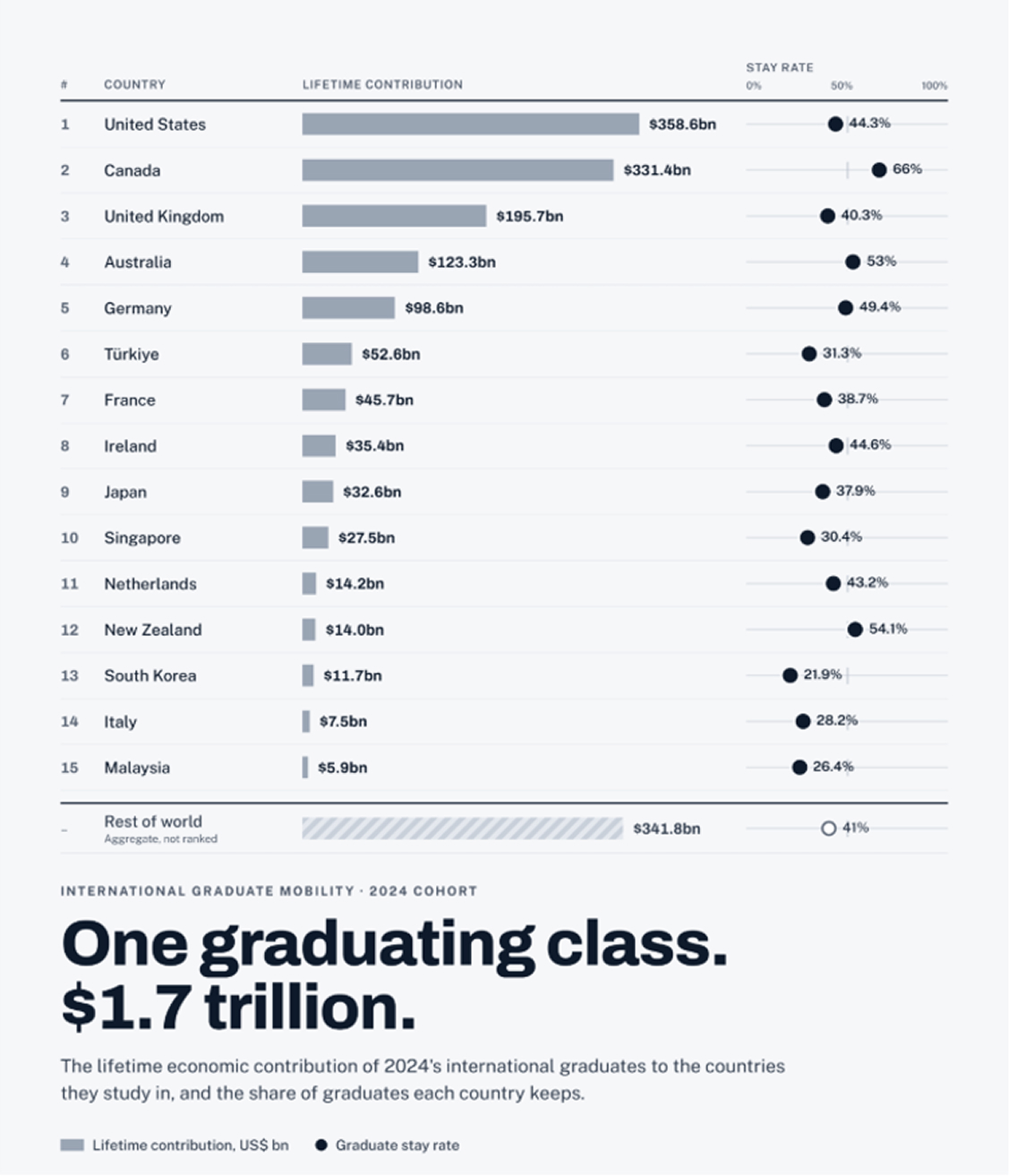
The report finds that this value is concentrated in the United States, United Kingdom, Australia and Canada. While the 'Big Four' host just 35% of the world's international students, they account for almost 60% of total first-year economic output. Together, these four destinations generate an estimated USD 1 trillion in lifetime value from the international students that graduated in 2024. For reference, that’s equal to the 2025 GDP of Switzerland.
To provide a representative global estimate, the analysis focuses on fifteen major international study destinations, where the best data is available and which collectively host approximately 60% of the world's internationally mobile students.
The report also compares the lifetime economic contribution of those graduating in 2024 and entering the workforce in 2025 for these countries. It also shows the percentage of international graduates who stay to work in their host country. The stay rate is based on Studyportals’ global dataset containing over half a million international graduates.
International graduates help fill critical skills gaps
Talent Beyond Borders also looks at how international graduate Stayers fill an important role in shortage-affected sectors, in particular including Medicine and Health, Engineering and Technology, and Computer Science and IT. Across these shortage-relevant fields, Stayers are the largest persona, accounting for 48% of Medicine and Health graduates, 59% of Engineering and Technology, and 56% of Computer Science & IT.
Find out more