Why do we need a Life Competencies Framework?
Our world is changing all the time and we can support our students to build skills and experiences beyond learning an additional language. At Cambridge, we understand that the engaging and collaborative nature of the language classroom provides an ideal context to develop and embed these key qualities.
We work with educators and researchers to understand how these skills – Cambridge Life Competencies – can integrate seamlessly into your English language programme.
Download our introductory guide
What does the Cambridge Life Competencies Framework look like?
The Framework outlines six key areas of Competency that are important for development: Creative Thinking, Critical Thinking, Learning to Learn, Communication, Collaboration and Social Responsibilities.
These Competency areas are linked to three foundation layers – emotional development, digital literacy and subject knowledge. Foundation layers are not separate Competencies. They underpin and weave through all the Competencies.
The Framework gives a complete view of transferable skills, all detailed within one system, and shows how these skills develop across different stages of the learning journey.
By clearly defining these core areas of development we can ensure that our teaching and learning materials take a comprehensive approach to delivering and developing these skills in our learners as they progress. This means that teachers can be assured that our resources bring out the best in their students.
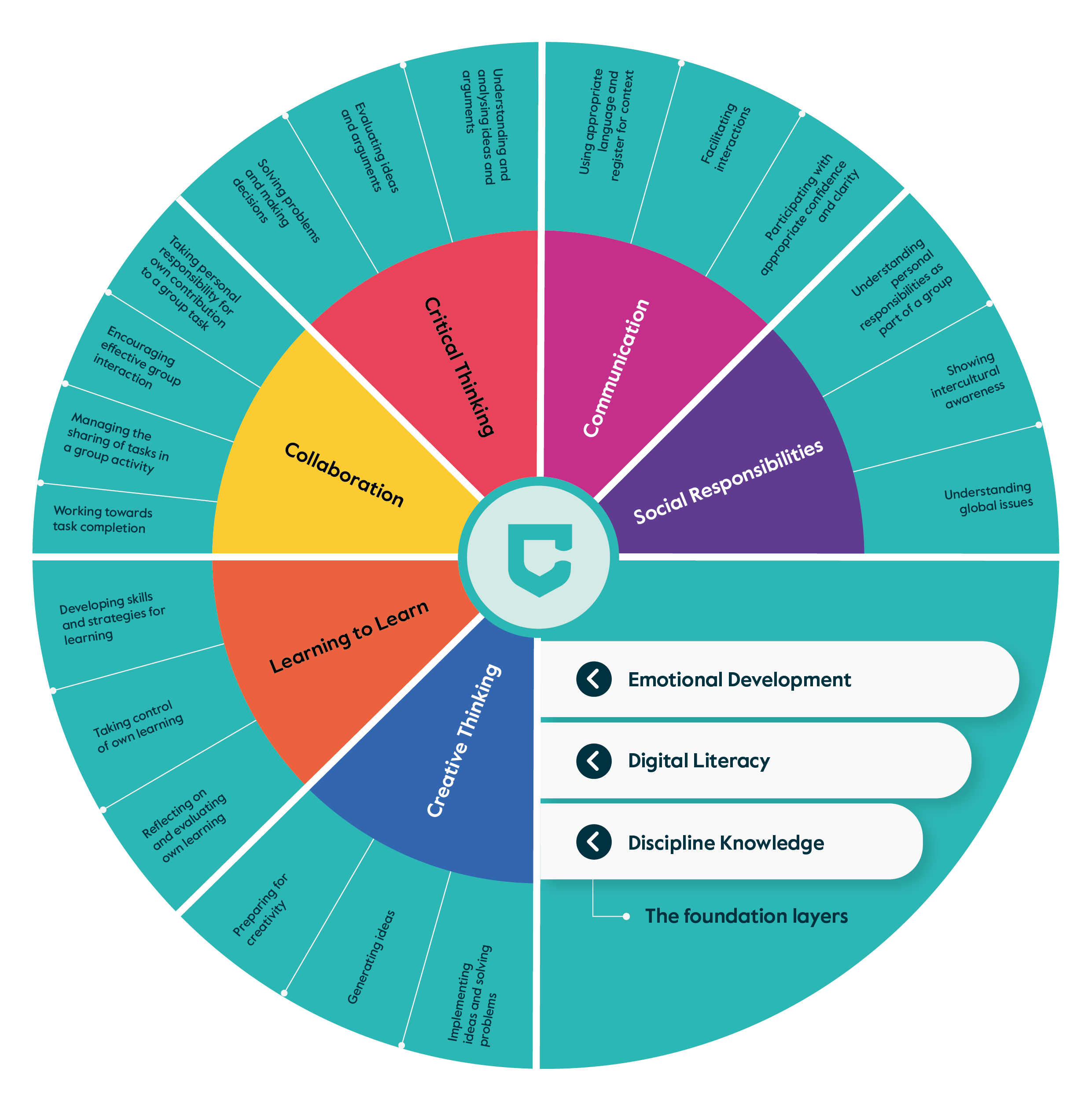
The framework groups the life skills we want students to develop into six main competencies with three foundational layers (Emotional Development, Digital Literacy and Discipline Knowledge) that weave through all of these skills.
| Competency |
Core areas |
| Creative Thinking |
Preparing for creativity
Generating ideas
Implementing ideas and solving problems |
| Learning to Learn |
Developing skills and strategies for learning
Taking control of own learning
Reflecting on and evaluating learning |
| Collaboration |
Taking personal responsibility for own contribution to a group task
Encouraging effective group interaction
Managing the sharing of tasks in a group activity
Working towards task completion |
| Critical Thinking |
Understanding and analysing ideas and arguments
Evaluating ideas and arguments
Solving problems and making decisions |
| Communication |
Using appropriate language and register for context
Facilitating interactions
Participating with appropriate confidence and clarity |
| Social Responsibilities |
Understanding personal responsibilities as part of a group
Showing intercultural awareness
Understanding global issues |
The Framework was originally based on research focused on neurotypical expressions of Competencies, as awareness of neurodiversity was more limited at the time. When using the Framework, it’s important to stay flexible and recognise that learners may show Competencies in many valid and different ways.
How do we use it in our products?
The Framework is used as a basis for our curriculum design. The content, texts and activities in our learning materials bring out key skills such as collaboration and critical thinking in our learners, while teaching them about language more generally.
This means that our materials enable learners to develop these skills without teachers having to completely change their approach or do anything extra.
How does it benefit learners and teachers?
The Framework describes how these integral life skills vary across different stages of education, as learners grow and change. This means that we understand what learners need to do to progress and develop.
Each broad Competency is broken down into 'Can Do' statements that describe the observable behaviours that learners are likely to be able to demonstrate by the end of each stage of learning. This enables us to support learners right through their learning journey and into their future.
How did we develop it?
Our research-driven perspective combined with knowledge from classroom practice has helped us create a framework that is rigorous and robust.
Our extensive analysis of existing approaches to life skills combined with input from educators from around the world means that the Cambridge Life Competencies Framework fits seamlessly into your language classroom in a useful and practical way.